
Online Scam Protection Guide (2026 Update)
The internet makes earning extra money easier than ever.
It also makes scamming easier than ever.
If you’re exploring paid surveys, focus groups, or side hustles, you must know how to spot red flags before you give out personal information.
This guide will show you:
- The most common online scams in the survey space
- How fake survey sites operate
- AI-powered job and voice scams
- Red flags to watch for
- What to do if you already shared information
This is your complete scam protection playbook for 2026.
Jump to Specific Scam Guides
To go deeper, explore current guides:
- Survey Scams to Avoid in 2026
- How Scammers Make Fake Survey Websites (Behind the Scenes) — 2026 Guide
- AI Job Interview Scams Explained
- How to Verify If a Survey Site Is Legit
- What To Do If You Gave Information to a Scam Site (2026 Recovery Guide)
- Legit vs Fake Survey Sites: Side-by-Side Comparison Guide (2026)
- AI Job Interview Scams Explained
Why Scam Protection Matters in the Survey World
The paid survey industry is legitimate. Companies pay for consumer opinions every day.
Real platforms like:
- Swagbucks – Read Review
- InboxDollars – Read Review
- YouGov – Read Review
have been around for years.
But scammers create fake versions, fake “premium access” offers, and fake job opportunities to trick users.
That’s why SurveyBeta always recommends starting with verified platforms from our Paid Survey Guide.
The Most Common Survey & Online Scams in 2026
1️⃣ Fake “Premium Survey Access” Scam
The Hook:
“Unlock $50 surveys when you pay a small $20 activation fee.”
The Reality:
Legitimate survey sites do NOT charge membership fees.
Red Flags:
- Upfront payment required
- Only crypto or gift card payments accepted
- No real company address
- Poor grammar and fake testimonials
2️⃣ AI Recruitment & Voice-Cloned Interview Scams
Scammers now use AI tools to:
- Clone recruiter voices
- Conduct fake video interviews
- Send professional-looking job emails
The Goal:
Steal your SSN, banking info, or charge “equipment fees.”
Remember:
Real survey companies do not:
- Ask for equipment deposits
- Request full Social Security numbers upfront
- Hire through Telegram or WhatsApp
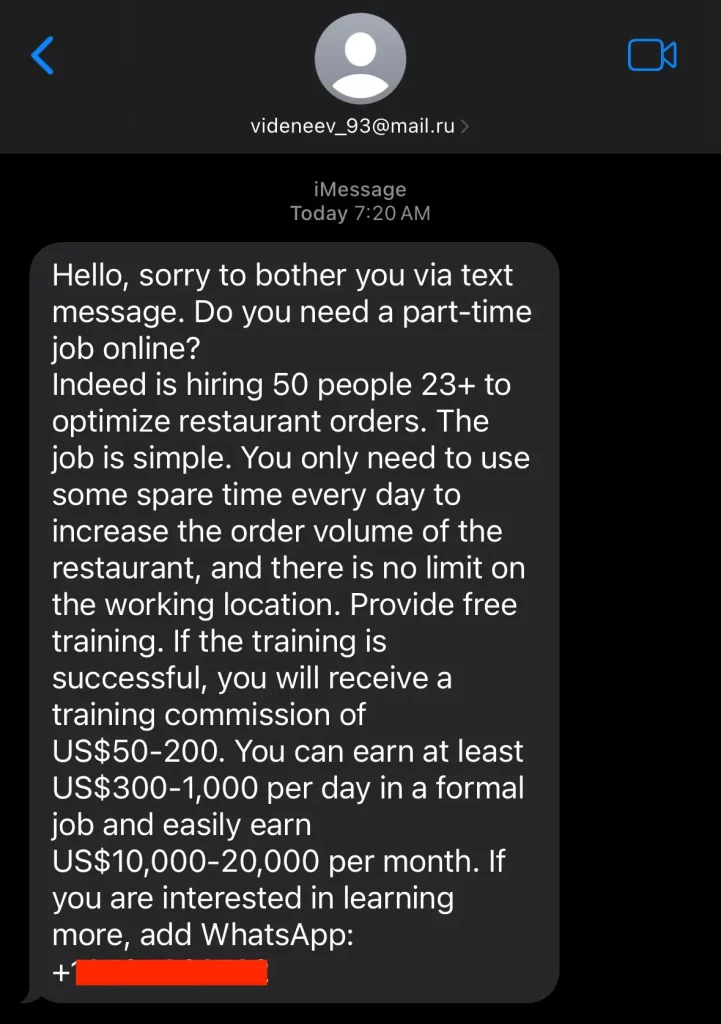
3️⃣ Task-Based “Boosting” Scams (Telegram & WhatsApp)
These scams promise:
- $200–$500 per day
- Simple “app boosting” or “product optimization” tasks
- Instant crypto payouts
You’re asked to:
- Deposit money to “unlock tasks”
- Keep depositing more to withdraw earnings
Then your account gets frozen.
These are not survey platforms.
They are structured payment traps.
Example of a text based job scam below:
4️⃣ Fake Survey Clones of Real Companies
Scammers create copycat websites that look like:
- InboxDollars
- Freecash
But the URL is slightly altered.
Example:
- inboxdollars-rewards.net
- freecash-bonus2026.com
Always check:
- Exact domain spelling
- HTTPS security
- Official social media links
10 Red Flags Every Survey User Should Know
If you remember nothing else, remember this checklist:
- ❌ They charge a sign-up fee
- ❌ They guarantee unrealistic earnings
- ❌ They pressure you to act immediately
- ❌ They only accept crypto payments
- ❌ They ask for full SSN immediately
- ❌ No clear privacy policy
- ❌ No contact info or support
- ❌ Poor website grammar
- ❌ Brand-new domain registration
- ❌ Communication only through messaging apps
Legitimate survey sites:
- Are free to join
- Pay modest amounts
- Have public reputations
- Have long histories
How to Verify If a Survey Site Is Legit
Before joining any platform:
✔ Step 1: Search “[Site Name] + reviews”
Look for consistent history.
✔ Step 2: Check Domain Age
Scam sites are often only weeks old.
✔ Step 3: Confirm Payment Proof
Look for real withdrawal discussions — not stock photos.
✔ Step 4: See If It’s Listed on SurveyBeta
We only review platforms that meet baseline legitimacy standards.
✔ Step 5: Check the TrustPilot Website
To stay safe while earning online, always stick to verified platforms. You can find a list of legitimate, vetted international survey sites that have proven payment histories and transparent reward systems.
Check out the rating fo the site here: TrustPilot.com
Not sure which survey platform to choose? Try our SurveyBeta Survey Compare Tool.
SurveryBeta’s “How To Verify Any Platform” (The 3-Step Rule)
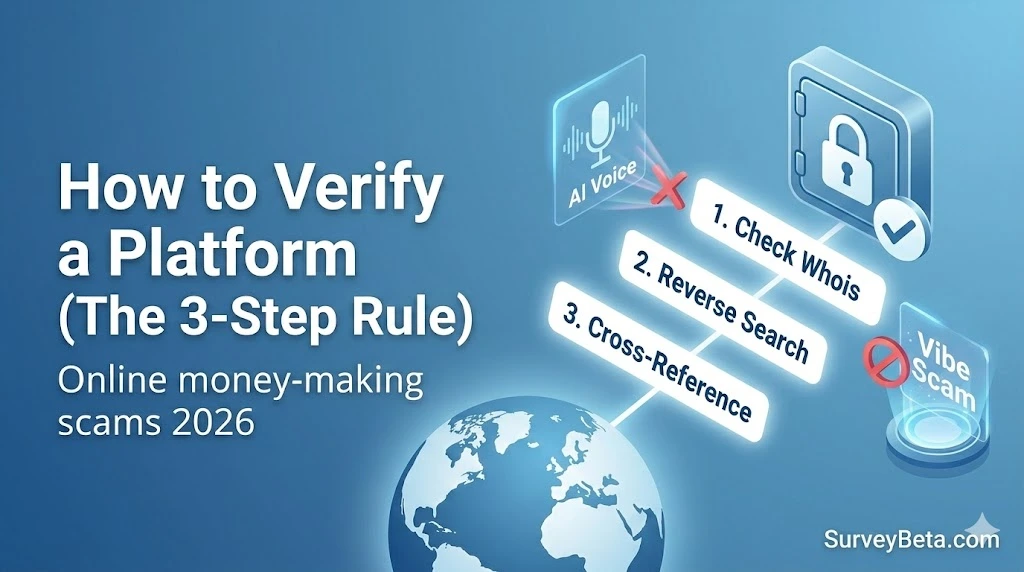
- Check the “Whois” Data: Use a tool to see when the website was created. If a “global earning leader” was registered only 3 weeks ago, it’s a scam.
- Reverse Search the Media: Use Google Lens on the “team member” photos. Scammers often use AI-generated faces or stock photos of doctors and models.
- Cross-Reference on Social Media: Search Twitter (X) or Reddit for the site name + “scam.” If the only reviews are 5-star “glow” reviews from accounts with no followers, be wary.
Skip the scams and start earning safely. Check out our expert-vetted Paid Survey Reviews to see which sites are actually worth your time.
What To Do If You Shared Information With a Scam Site
Don’t panic. Act quickly.
If You Gave:
Credit Card Info
- Contact your bank immediately
- Freeze or replace the card
Bank Account Info
- Call your bank fraud department
- Monitor transactions daily
SSN
- Consider placing a credit freeze
- Monitor credit reports
Passwords
- Change passwords immediately
- Enable two-factor authentication
Speed matters.
Who To Contact For Fraud
- Contact your Bank: Freeze all accounts and report “Unauthorized Fraudulent Activity.”
- Report to the FTC: Visit ReportFraud.ftc.gov to help authorities track the trend.
- File an IC3 Complaint: For online-specific crimes, the FBI’s Internet Crime Complaint Center (IC3) is the primary resource.
- Change Your MFA: If you used a password on a scam site that you use elsewhere, change it immediately and enable Phishing-Resistant MFA (like a YubiKey or Authenticator app).
If you realize you’ve shared information or lost money, act in this order:
Why SurveyBeta Emphasizes Safety
SurveyBeta has reviewed survey platforms for years.
Our process focuses on:
- Payment transparency
- User history
- Company background
- Privacy standards
We do not recommend platforms that:
- Charge fees
- Hide ownership
- Have consistent fraud complaints
If you’re unsure where to start, visit our Best Paid Survey Sites page to see verified options.
Final Scam Protection Principles
- Real survey sites never charge membership fees.
- No legitimate survey company guarantees high income.
- If it feels rushed, emotional, or secretive — step back.
- Always verify before providing personal information.
Scammers rely on urgency.
You win by slowing down.
Top Scams to Watch Out for This Year 2026
| Scam Type | The Hook | The Goal |
|---|---|---|
| AI Recruitment | A “Recruiter” finds you on LinkedIn and does a voice-cloned interview. | Stealing your SSN and bank info for “payroll setup.” |
| Survey “Early Access” | A site promises $50 per survey for “premium members” who pay a $20 fee. | Stealing the $20 fee and your credit card data. |
| Virtual Assistant Malware | A job offer requires you to download a specific “task management” VPN. | Installing spyware to capture your banking passwords. |
| Task-Based “Boosting” | You are paid to “click” products to boost ratings, but must deposit money to “unlock” higher levels. | A classic Ponzi scheme that vanishes once you deposit a large sum. |
| Term | What It Means |
|---|---|
| Activation Fee Scam | A fraudulent offer that requires users to pay money to unlock “premium” surveys or higher payouts. Legitimate survey sites are always free to join. |
| Typosquatting | A scam tactic where criminals register domain names that closely resemble legitimate websites using letter swaps, missing characters, or slight spelling changes. |
| Clone Phishing | A fake website or email that copies the design and branding of a real company in order to steal login credentials and personal information. |
| Quishing | QR-code phishing. Scammers use malicious QR codes in emails, text messages, or public spaces to redirect victims to fake login pages. |
| Voice Cloning Scam | An AI-powered fraud method where scammers replicate a recruiter’s voice to conduct fake interviews and request sensitive information. |
| Task Boosting Scam | A scheme promising high daily earnings for simple app or product “optimization” tasks, but requiring deposits to unlock higher payout levels. |
| Identity Harvesting | The collection of highly sensitive personal data such as Social Security numbers, bank account details, or ID photos under false pretenses. |
| Domain Age | The length of time a website has existed. Scam platforms are often newly registered domains with little online history. |
| Recovery Scam | A follow-up scam targeting victims who already lost money, promising to recover funds for an upfront fee. |
| Social Engineering | A psychological manipulation tactic where scammers create urgency, fear, or authority to pressure victims into revealing sensitive information. |
| Phishing-Resistant MFA | Advanced multi-factor authentication methods, such as hardware security keys or authenticator apps, that are harder for scammers to bypass. |
🛡 Bottom Line
Paid surveys can be a legitimate way to earn extra money.
But smart users protect themselves first.
Use this guide as your filter.
If you stay cautious, verify platforms, and avoid anything asking for upfront payment — you dramatically reduce your risk.
Stay informed. Stay skeptical. Stay protected.
FAQ: Protecting Your Earnings in 2026
Unfortunately, no. Crypto transactions are irreversible by design. This is why scammers prefer it. If anyone tells you they are a “Recovery Agent” who can get your crypto back for a fee, they are part of a secondary scam.
Scammers buy leaked data from old hacks. In 2026, AI bots can send millions of personalized texts per minute. Never click the link; block and report the number as spam.
No, but the pay is modest. A site promising $100 for a 10-minute survey is almost certainly a scam. Legitimate sites like SurveyBeta focus on realistic rewards and never ask for payment to join.
Ask a “human” question that requires emotional nuance or current, local context (e.g., “What’s the weather like outside your office right now?”). AI clones often have a “flat” rhythm or delay when answering unscripted questions.
In 2026, “Quishing” (QR phishing) is a major threat. Scammers place fake QR code stickers over legitimate ones in public spaces or send them via email to bypass spam filters. These codes can redirect you to “vibe scams” designed to steal your login credentials. Always verify the destination URL before entering data, and avoid scanning QR codes from unsolicited emails or unverified physical ads.
Be extremely careful: This is often a “follow-up scam.” In 2026, scammers target people who have already been victimized, posing as “ethical hackers” or “recovery agents” who claim they can retrieve lost crypto or wire transfers for a fee. Legitimate recovery is handled only by banks and law enforcement (like the FBI’s IC3). Anyone asking for an upfront “recovery fee” is trying to scam you a second time.

With 12+ years in consumer research and digital behavior analysis, Sarah helps readers understand which survey sites and earning apps are truly worth their time. Her reviews focus on simplicity, honesty, and real-world results.
–OR–